
AI Training Data Sourcing: Vendor Playbook 2026
The AI industry has reached an inflection point. In 2023, the bottleneck was GPU availability. By 2026, compute is abundant — but high-quality, legally sourced training data has emerged as the tightest constraint for frontier and vertical AI labs alike. The era of “throw another trillion tokens at it” is over. Curated, high-signal datasets now outperform raw bulk scrapes by 3-10x on downstream benchmarks.

This playbook is for the person who has to actually operate the data pipeline. It is not a vendor ranking or a strategic-buyer pitch. It is an ingestion-boundary view of AI training data operations. The argument is simple: AI training data ops is dominated by four operational properties — freshness, schema stability, vendor handoff cleanliness, and lock-in cost. Sourcing mode choice should be made along these axes, not based on feature comparisons or vendor reputation.
The data pipeline accounts for roughly 80% of AI success, with the model itself contributing the remaining 20%. Teams typically spend 60 to 80% of their time on data preparation rather than model development. The work you are doing on this pipeline is where the budget is going.
Part I: The Ingestion-Boundary View
What AI Training Data Actually Costs You to Operate
Strategic literature treats training data as an asset. Operational literature treats it as an ingestion-boundary contract. The second view is more useful because it surfaces what your team will actually have to maintain.
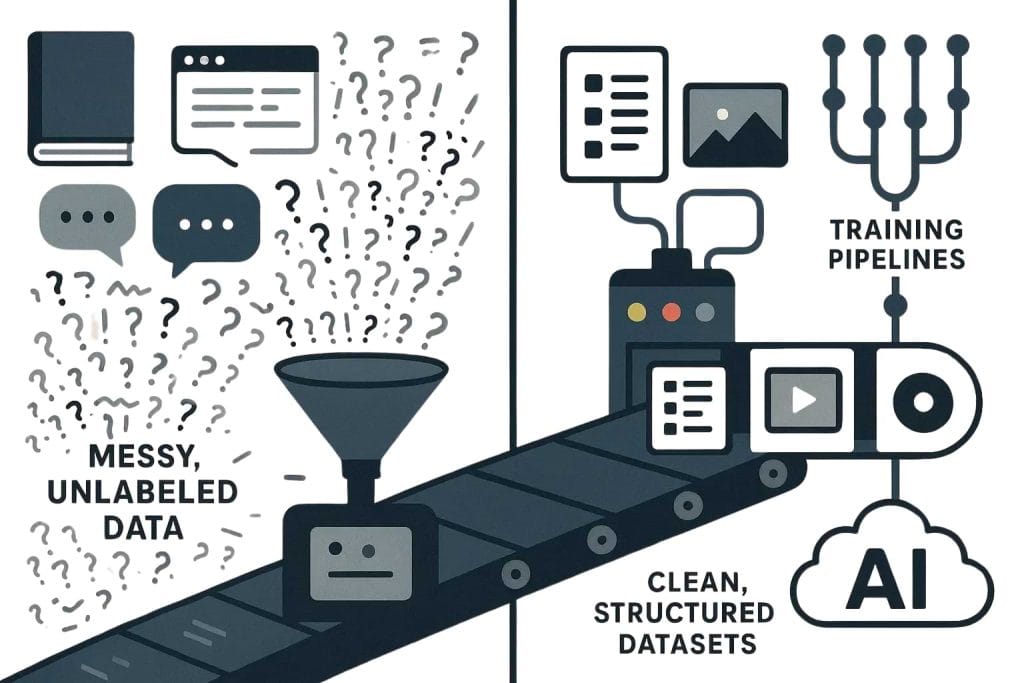
A training-data pipeline runs in five stages: sources (internal databases, web extraction, vendor feeds, licensed datasets, synthetic generators) flow through ingestion (scheduled or streaming), through validation (schema checks, completeness, distribution), through versioning (semantic dataset versions, lineage), into consumption (training, fine-tuning, evaluation pipelines). Each stage has its own SLO, failure mode, and change-management cost.
The Four Operational Properties That Determine Total Cost of Ownership
Expert Insight: “ML researchers debate model architecture. ML engineers operate the ingestion. The practitioner literature has been written for the first group; this article is written for the second. The four operational properties matter more than the sourcing mode. Get them wrong and no vendor change recovers the cost.”
Part II: Data Freshness and Data SLOs
The Single Most Underweighted Decision
Most teams set freshness aspirationally. “We update daily” turns out to mean the daily job runs. Whether the data inside it reflects what changed at the source is a separate question.
A data SLO makes the freshness question contractual. The pattern that has matured in 2025 and 2026 is the same shape data engineering uses for warehouse pipelines: 99.9% of daily pipelines succeed, and data freshness is under one hour of source-side lag, measured per source-tier rather than at the pipeline level. Observability tooling has extended upstream from the warehouse into the ingestion layer to make this measurable: arrival on schedule, schema drift detection, volume anomaly detection, and increasingly LLM-style data quality bots that flag pre-training distribution issues before faulty data reaches the model.
Freshness Band by Retraining Cadence
| Retraining Cadence | Recommended Freshness Target | Notes |
|---|---|---|
| Real-time/continuous fine-tune | Per refresh | Flag staleness explicitly to consumers |
| Sub-hour dynamic sources | < 1 hour | Observability + alerting must be sub-15-min |
| Daily fine-tune | 1 to 4 hours | The common case for B2B SaaS use cases |
| Weekly retrain | 24 to 48 hours | Freshness above this band is wasted spend |
| Monthly evaluation | Weekly | Freshness above this band is wasted spend |
Critical insight: Buying tighter freshness than your model retains is wasted spend. Buying looser freshness than your retrain cadence is a silent quality decay. Both are common; the second one hurts more because nobody finds it until the eval set drifts .
Freshness Alone Is Insufficient
A second point most articles miss: Freshness alone is not enough. You also need distribution stability. A pipeline that arrives on time but has shifted its statistical properties is no better than a stale one, and is sometimes worse because the appearance of freshness reduces scrutiny. Pair freshness SLOs with distribution monitoring at the dataset level (KL-divergence, feature-level drift on embedding distributions, gold-label drift on evaluation sets).
Part III: Schema Versioning and Data Contracts
What Stops Training Sets from Quietly Breaking
Schema drift is the silent failure mode of training data ops. The producer changes a field type, splits a column, renames a key, or moves a value under a different parent. Your ingestion job runs to completion. The validation step, if you have one, may even pass on rules written before the change. The training set updates. The model trains on slightly wrong data, evaluates against slightly wrong evals, and ships into production with a quality regression nobody can immediately localize.
Two practices stop this:
Practice 1: Dataset Versioning
Every published dataset gets a semantic version. Tools like DVC, LakeFS, and git-LFS make this enforceable; lineage in a feature store keeps consumer-side joins explicit. When something breaks, you can revert to a known-good version, retrain in parallel, and A/B compare. Without versioning, drift is detected late, and recovery is a forensic exercise.

Practice 2: Data Contracts
A data contract is a typed, validated, CI-enforced agreement between producer and consumer. The pattern moved from theory into everyday data-engineering practice during 2024 and 2025; for AI training data, it is now table-stakes for any external source.
A Vendor-Grade Data Contract Has Seven Fields
- Typed schema — Fields, types, and nullable flags. Versioned. Backward-compatible for at least one prior version.
- Validation rules — Range checks, enum sets, referential integrity. CI-tested in the producer’s pipeline before delivery.
- Freshness guarantee — SLO or SLA tied to a measurable freshness latency per source tier.
- Idempotency keys — A stable per-record identifier so replays produce the same dataset, not duplicates.
- Replay support — A documented mechanism for re-delivering N days of data without producing duplicates downstream.
- Retention policy — How long the source retains its historical state, and what your contractual access to it is.
- Exit and data-portability clause — What happens at termination? Who keeps what? How to export the schema and full historical state?
Expert Insight: “A vendor without these seven is selling a feed, not a service. ‘We will add data contracts later’ is the most expensive technical debt in this space. Adding contracts after a pipeline is in production costs 4 to 10 times as much as building them in. The cheapest contract is the one negotiated at vendor selection.”
Part IV: Sourcing Modes — In-House, Managed External, Licensed, Synthetic
The 4-Mode Comparison on Operational Axes
Operational Facts About Each Mode
In-house extraction wins when sources are bounded, static, and you can absorb the maintenance. The maintenance band typically spans 30-60% of relevant engineering hours at scale, depending on source count and anti-bot pressure.
Managed external works best when you need domain-specific, high-quality, annotated, and compliant datasets at scale without overloading internal teams. Most successful projects mix sources: public data for prototyping, internal data for domain relevance, and external vendors when you need scale, diversity, compliance, and expert annotation

Licensed corpora are increasingly the preferred route for foundation model builders who need to avoid copyright litigation. Leading AI providers (OpenAI, Google) have shifted toward licensing high-quality, long-context data directly from publishers and video platforms.
Synthetic data can complement real-world data in some scenarios (rare events, controlled variations), but should not completely replace real data. Synthetic data should be validated against real-world patterns.
Part V: The Vendor Evaluation Framework
The Four Pillars of Modern Training Data Sourcing
Pillar 1: Legal & Compliance Framework
Before a single URL is fetched, serious AI teams establish :
- Crawling permissions: Does the source allow programmatic access? What do robots.txt, Terms of Service, and crawl-delay directives specify?
- Content licensing: Is the content under CC, Creative Commons variants, public domain, or proprietary copyright?
- Personal data handling: Are there PII, PHI, or GDPR/CCPA-relevant elements? If yes, what’s the removal plan?
- Attribution requirements: Does the license require author credit, source URLs, or use restrictions?
- Commercial vs non-commercial use: Many sources allow research use but restrict commercial training.
- Regional law exposure: EU AI Act, CCPA, PIPEDA, and upcoming US federal AI legislation
This is why leading AI labs are hiring dedicated data counsel and why data provenance documentation has become a board-level discussion .
Pillar 2: Technical Infrastructure
Web-scale data collection requires infrastructure at a scale most startups cannot build in-house :
- Distributed crawling across thousands of concurrent proxies and user agents
- JavaScript rendering for modern single-page apps (SPAs), which require headless browser farms
- PDF, document, and multimedia extraction — PDFs, DOCX files, images, videos, and audio all need specialized parsers
- Incremental crawling — re-crawling efficiently only when content changes
- Duplicate detection at URL, content-hash, and semantic levels
- Language detection — critical for multilingual models
- Content classification — filtering for quality, topic, toxicity, and relevance
Pillar 3: Data Quality & Curation
This is where most teams fail. Raw web data is 90%+ noise :
- Boilerplate extraction — stripping navigation, ads, footers, cookie banners, and templated content
- Quality scoring — using small classifier models to score content for educational value, factual density, and grammatical quality
- Toxicity filtering — removing hate speech, violence, CSAM, and other harmful content categories
- PII scrubbing — automated redaction of names, addresses, phone numbers, SSNs, credit cards, health information
- Deduplication at scale — semantic deduplication across billions of documents using minhash, SimHash, or embedding-based methods
- Domain balancing — ensuring training data isn’t dominated by a single source or content type
Pillar 4: Provenance & Auditability
Modern AI labs maintain full provenance logs for every token of training data :
- Source URL and crawl timestamp
- robots.txt state at time of crawl
- Content license classification
- Extraction pipeline version
- Quality scores and filter decisions
- PII redaction audit log
This is not optional. Investor due diligence, enterprise customer audits, and litigation defense all require provenance .
Data Quality Signals to Look For
When evaluating training data — whether from a vendor or internal sources — these metrics matter :
- Demographic and linguistic diversity: For global deployments, does the data represent your actual user base?
- Annotation depth: Are annotations binary labels or rich, multi-attribute annotations that capture nuance?
- Label consistency: Do labels stay consistent when the same item is reviewed twice?
- Edge case coverage: Does the data include rare but important scenarios, or only the “happy path”?
- Temporal relevance: Is the data current enough for your domain? Financial or news-oriented models need recent data.

Part VI: Specialized Data Categories in Demand
What AI Teams Are Actually Sourcing in 2026
The Video Data Gold Rush
The landscape for video training data in 2026 is defined by a shift from quantity at all costs to highly curated, licensed, and specialized datasets. Foundation model builders need highly specific and granular video data for training, and the provenance of copyright needs to be established.
Emerging platforms are creating two-sided marketplaces connecting content creators with AI labs. For example, AI training labs may request very specific content — “10 hours of white wedding balloons” or “a close-up of a woman’s hand tying a shoelace.” Anyone with a smartphone can be a source of this training data
C2PA manifests have become critical: they serve as the “DNA” of the data, providing a cryptographically signed record of origin and history. Increasingly, C2PA manifests are required to protect against model collapse, as the volume of AI-generated video grows and there is an increasing risk of models being trained on their own synthetic outputs.
Part VII: Cost Benchmarks for AI Training Data in 2026
| Data Type | Cost Range |
|---|---|
| Bulk web corpus (raw) | $0.0001 – $0.001 per 1K tokens |
| Cleaned, deduplicated, quality-filtered corpus | $0.001 – $0.01 per 1K tokens |
| Domain-specific curated corpus | $0.01 – $0.10 per 1K tokens |
| Instruction-response pairs (human-generated) | $0.50 – $5.00 per pair |
| RLHF preference pairs | $2 – $15 per pair |
| Expert annotations (medical, legal, code) | $5 – $50+ per annotation |
A medium-sized vertical AI company building a 70B-parameter fine-tuned model typically budgets $500K – $5M annually for training data — often split 60/40 between crawling infrastructure and human annotation.
Part VIII: Vendor Evaluation Checklist
When narrowing the field, replace generic capability claims with concrete checks. Ask each candidate to demonstrate :
- A real sourcing program with documented consent and commercial training rights
- An SFT and RLHF data workflow staffed by domain experts, with a sample preference rubric
- An evaluation set policy that prevents training contamination across versions
- A red-team capability with examples from the candidate’s regulated-industry work
- A drift program that ties production sampling to your team’s retraining cycles
- Dataset cards and audit logs that map to EU AI Act Article 10 and Article 12 requirements
- Self-hosted data delivery is available as a default, not an enterprise upsell
Treat Data as a Lifecycle Commitment
Enterprise support for training AI models is not a procurement category. It is a lifecycle commitment that runs from sourcing through alignment, data collection, evaluation, drift sampling, and retraining-cycle data.
The data partners worth working with treat each of those workstreams as connected pieces of one system, document them in a way regulators can read, and deliver them inside the client’s perimeter when the data demands it — leaving the actual training, compute, and deployment to the client’s MLOps team where they belong.
The companies that win in the AI space will be those that treat their data as a strategic asset, investing in reputable vendors and the right acquisition strategies. As the data pipeline accounts for 80% of AI success, the sourcing decisions you make today will determine your competitive position for years to come.