
Synthetic vs. Curated Data for LLMs in 2026
The debate over synthetic versus curated data for training large language models has moved from academic circles to the core of enterprise AI strategy. For years, the industry operated on a simple assumption: more data equals better models. That era is ending.
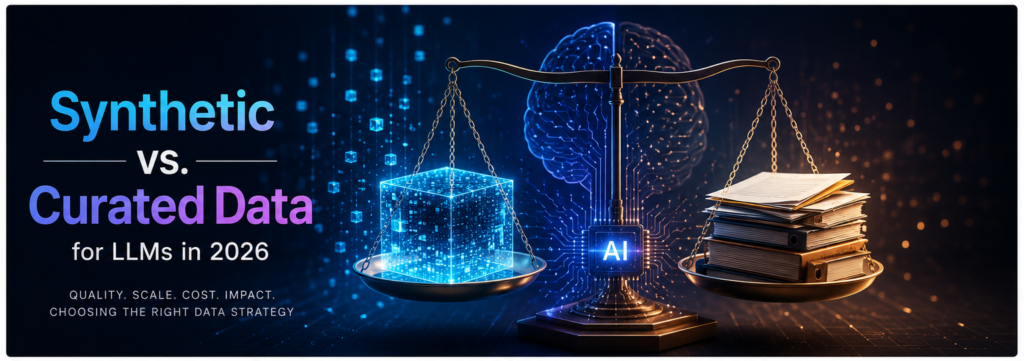
Recent research from 2026 has revealed a more nuanced truth: data quality and distribution matter as much, if not more, than quantity. The choice between synthetic generation and human curation is not a binary decision—it is a strategic calibration that depends on your model’s training stage, domain, and deployment environment.
This guide examines the synthetic vs. curated data debate through the lens of 2026 research and practice. We will explore what each approach offers, where they fail, and how leading AI teams are combining them to build production-grade systems.
Why This Debate Matters in 2026
Understanding the difference between synthetic and curated data is critical for several reasons:
- Model performance depends on data quality. Research has demonstrated that quality can significantly boost performance and training efficiency. The German-language Aleph-Alpha-GermanWeb project showed that combining heuristic filtering, model-based curation, and synthetic generation outperformed larger, uncurated datasets—even when the uncurated data included high-quality sources like Wikipedia.
- Legal pressure on web scraping has intensified. The default approach of the early 2020s—scrape the internet and train—has become increasingly untenable. Enterprise customers now demand transparency about training data provenance.
- Cost optimization matters. Synthetic data is significantly cheaper to produce than human-curated data, but carries different risks. Understanding the tradeoffs helps teams allocate budget effectively.
Part I: The Three Data Creation Methods
Today’s AI data ecosystem recognizes three primary production methods:
| Method | Definition | Best Use Case |
|---|---|---|
| Synthetic | Fully generated content (text, images, tabular records) produced by models, simulators, or rule-based programs | Rare scenarios, privacy-safe surrogates, volume bootstrapping |
| Semi-Synthetic | Real samples extended through controlled augmentations (transformations, paraphrasing, overlays) | Extending limited real data while preserving distributional grounding |
| Human-Curated | Deliberate collection and annotation by human contributors following defined taxonomy and quality standards | Safety-critical domains, regulatory compliance, preference optimization |

Part II: Synthetic Data — The Promise and the Peril
What Synthetic Data Does Well
Synthetic data has genuine utility in specific contexts:
- Covering rare or hazardous scenarios that are impractical to capture in the real world—vehicle rollovers, chemical spills, extreme weather edge cases
- Generating privacy-safe surrogates for regulated datasets where real data cannot be shared
- Bootstrapping model training when real data does not yet exist in sufficient volume
- Enabling rapid scaling of certain training stages without waiting for data collection
The OpenThoughts-Agents project, whose data was curated using the Curator tool, demonstrated strong scaling properties for synthetic data in agentic model training. The Curator framework has been used to create high-quality reasoning datasets that outperform existing open data models.
Where Synthetic Data Fails
The well-documented failure mode of synthetic data is distribution shift. Synthetic generators can only produce distributions that reflect their underlying assumptions. When the real deployment environment differs from those assumptions, the model tends to break in unpredictable ways.
Key findings from 2026 research:
- Model collapse is real. A 2024 study demonstrated formally that models trained solely on synthetic data cannot avoid collapse over iterations. The statistical richness of the original human-generated distribution degrades with each generation. Mixing synthetic with real data mitigates this, but pure synthetic pipelines do not.
- Synthetic priors occupy a narrow region. A 2026 comparison of real and synthetic corpora for tabular foundation models found that synthetic priors occupy a narrow region of the space of real tables. This mismatch could not be closed by optimizing hyperparameters across more than 86,000 configurations.
- Generalization failure in natural data. A 2026 study comparing natural and synthetic structured data for French and Italian found that while models achieve ceiling performance when trained and tested on synthetic datasets, they do not reliably generalize to natural sentences. Models trained on natural data exhibited robust performance across both natural and synthetic test suites, demonstrating their superior ability to capture abstract linguistic patterns.
The Surprising Advantage of Synthetic Distribution
Despite these limitations, 2026 research has uncovered a counterintuitive insight: synthetic data can sometimes be more effective for certain training objectives than perfectly correct human data.
The NCA pretraining study (2026) found that a model trained on only 164 million synthetic, non-linguistic tokens improved downstream language modeling by up to 6% and accelerated convergence by 1.6x. This even outperformed pre-training on 1.6 billion tokens of natural language from Common Crawl.
Key insight: Optimal data complexity varies by domain—code benefits from simpler dynamics, while math and web text favor more complex ones.
Part III: Human-Curated Data — The Irreplaceable Foundation
What Human Curation Provides
Human-curated datasets are built through deliberate collection and annotation by human contributors—crowd workers, domain experts, or specialist annotators working to defined taxonomies and quality standards.
They are the only reliable source of distribution fidelity in domains where real-world signals contain nuance that no generator currently captures.
Domains Where Human Curation Is Non-Negotiable
According to the 2026 industry analysis, human curation is required in specific contexts:
- Safety-critical perception models (ADAS, surgical robotics, aviation)—annotation errors have direct physical consequences
- Legal, medical, and financial NLP—model output must be traceable to verified source data for regulatory compliance
- Low-resource language models—no pre-existing generative model has sufficient coverage to produce fluent, natural synthetic text.
- Preference optimization (RLHF/DPO)—the training signal is explicitly human judgment, not a distributional proxy
- Trust and safety content moderation—labeling taxonomy requires cultural and contextual knowledge
The risk of treating human curation as optional in these domains shows up as bias in generative AI systems—systematic errors that are invisible in evaluation metrics but damaging in deployment. Human annotators, when properly selected and calibrated, introduce diversity of judgment that generators cannot approximate.
The Challenge of Human Curation at Scale
Building AI-ready datasets at scale through human curation involves far more than running annotation tasks:
- Clear taxonomy design
- Trained annotators
- Consistent quality measurement
- Ongoing review cycles
- Structured feedback loops
Many internal teams underestimate these requirements until the project is already underway.

Part IV: Semi-Synthetic Data — The Practical Middle Ground
What Semi-Synthetic Data Is
Semi-synthetic data combines real-world samples with generated augmentations:
- Weather overlays applied to real camera frames
- Paraphrase generation seeded from authentic customer conversations
- Augmented LiDAR returns are layered onto real point cloud captures
The real samples anchor the distribution, and generated augmentations extend coverage and volume without introducing full simulator bias.
Why Semi-Synthetic Outperforms Pure Synthetic
Mixing any synthetic data type with real data substantially improves performance over using that synthetic type alone. The base real samples provide the distributional grounding that synthetic generators struggle to replicate from scratch.
For teams running multi-layered data annotation pipelines, semi-synthetic datasets often reduce the annotation burden by generating clear, controllable examples that are faster to label than noisy real-world captures.
Where Semi-Synthetic Introduces Risk
If the augmentation process does not preserve the statistical structure of the real samples, the hybrid dataset can mislead training. A paraphrase generator that systematically smooths out grammatical irregularities will produce cleaner training sentences than the model will ever see in production.
The fix: Augmentation pipelines need explicit quality controls, including human review of a representative sample to confirm that the generated portion does not distort the base distribution.
Part V: Training Stage Matters — What to Use and When
The Three-Stage View
The choice between synthetic and curated data should be calibrated to each training stage and model objective. The same program often needs synthetic coverage, semi-synthetic augmentation, and human-curated ground truth at different points.
Key findings from 2026 research:
| Training Stage | Recommended Data Mix | Rationale |
|---|---|---|
| Pretraining | Primarily curated web/domain data; synthetic for domain-specific bootstrapping | Model-based curation significantly enhances performance; synthetic can effectively supplement limited real data |
| Supervised Fine-Tuning | Semi-synthetic (real + generated instructions) | Real samples provide distributional grounding; generated augmentations extend coverage. |
| Preference Optimization (RLHF) | Human-curated only | The training signal must be explicit human judgment, not a distributional proxy. |
| Evaluation | Human-curated ground truth | Synthetic evaluation masks system limitations discovered with human data |
The Japanese Synthetic Data Study
A 2026 study on scaling data-constrained language models with synthetic data for Japanese found that synthetic Japanese corpora outperformed both data repetition and using English Web text when filling a data shortfall. The synthetic data approached the performance achieved when the entire token budget was filled with additional organic Japanese Web text.
Key insight: For low-resource or data-constrained scenarios, synthetic data can be a powerful remedy, provided the generating model is capable of producing fluent, high-quality outputs.
Part VI: Emerging Approaches in 2026
EmbGen: Teaching with Reassembled Corpora
EmbGen is a 2026 synthetic data generation pipeline that decomposes a corpus into entity-description pairs, reassembles them using semantic structure inferred from embedding similarity, and generates question-answer pairs via proximity, intra-cluster, and inter-cluster sampling.
Results: EmbGen improved Binary Accuracy on the most heterogeneous dataset by 12.5% at 5 million tokens and 88.9% at 20 million tokens relative to the strongest baseline, while remaining competitive across other datasets with lower heterogeneity.
StateGen: State-Grounded Multi-Agent Generation
StateGen is a 2026 synthetic data generation platform that produces scored, reasoning-trace-rich training conversations by orchestrating a four-role LLM loop: a persona-conditioned user simulator, an agent under test, a state-grounded tool simulator, and a multi-axis LLM judge.
Results: On 64,698 evaluated conversations across three production corpora, tool-call hallucination scores reached 9.66/10, and the system supports persona-driven variation via a 23-dimensional trait vector.
Curator Framework
The Curator framework, developed by Bespoke Labs, makes it easy to create synthetic data pipelines for post-training and structured data extraction. It supports multiple inference backends, including OpenAI, Anthropic, Gemini, together.ai, vLLM, and DeepSeek.
Key capabilities:
- Rich Python library for generating and curating synthetic data
- First-class support for structured outputs
- Built-in performance optimizations for asynchronous operations, caching, and fault recovery
- Integration for fine-tuning—go from curated data to a LoRA fine-tuned model in a few lines of Python
Part VII: The Enterprise AI Data Strategy
What Works in Production
Enterprise models operate in deployment environments that are messier, more variable, and more adversarial than any generator’s training assumptions. A 2025 MIT analysis noted that statistical similarity to a training distribution does not guarantee behavioral reliability in the target environment.
The practical answer for enterprise AI teams: Quality data remains the defining factor in generative AI outcomes, and quality is determined by how well the dataset represents the deployment distribution.
Recommended Approach
Based on 2026 research and practice, the recommended data strategy includes:
- Start with human-curated ground truth for evaluation and preference optimization
- Use semi-synthetic augmentation to extend limited real data while preserving distributional grounding
- Deploy synthetic generation for coverage of rare scenarios, privacy-safe surrogates, and volume bootstrapping
- Calibrate the approach to each training stage—pretraining, fine-tuning, and evaluation have different needs
- Implement quality controls for any generated data to confirm it does not distort the base distribution
Synthetic Data Fine-Tuning Results
A 2026 enterprise team formation study evaluated two synthetic data generation strategies:
(1) augmenting real-world data with synthetic labels
(2) generating synthetic profiles for employees tailored to specific tasks.
Results: Training a model that uses a combination of both synthetic data generation strategies outperformed already established pre-trained models on the Team Formation task, improving ranking metrics by an average of 30% in comparison to the best-performing pre-trained model.
Part VIII: Cost Benchmarks and Tradeoffs
Comparative Cost Structure
| Data Type | Cost Per Unit | Scalability | Quality Risk |
|---|---|---|---|
| Fully Synthetic | Very low | Infinite | Distribution shift, model collapse |
| Semi-Synthetic | Low | High | A distorted base distribution if not controlled |
| Human-Curated (General) | Moderate | Limited | Inconsistent annotation quality |
| Human-Curated (Expert) | High | Very limited | Scarcity of domain experts |
Return on Investment by Use Case
| Use Case | Recommended Approach | ROI Rationale |
|---|---|---|
| General pretraining | Curated web data + targeted synthetic | Model-based curation outperforms raw scale |
| Fine-tuning (known domain) | Semi-synthetic | Real samples ground distribution; augmentation extends coverage |
| Fine-tuning (data-constrained) | Synthetic generation | Can effectively supplement limited real data |
| Preference optimization | Human-curated only | The training signal must be human judgment |
| Safety-critical domains | Human-curated + synthetic testing | Human for ground truth; synthetic for edge cases |
Frequently Asked Questions
Q: What is the main difference between synthetic and curated data?
A: Synthetic data is fully generated by AI models or simulators. Human-curated data is collected and annotated by human contributors following defined quality standards.
Q: Can synthetic data completely replace human-curated data?
A: No. Models trained on synthetic datasets do not reliably generalize to natural sentences. Natural data produces robust performance across both natural and synthetic test suites.
Q: When should I use synthetic data?
A: Use synthetic data for covering rare scenarios, generating privacy-safe surrogates, and bootstrapping volume when real data is limited.
Q: What is semi-synthetic data?
A: Semi-synthetic data combines real-world samples with generated augmentations, preserving distributional grounding while extending coverage.
Q: Does synthetic data cause model collapse?
A: Yes. Models trained solely on synthetic data cannot avoid collapse over iterations. Mixing synthetic with real data mitigates this.
Q: Which approach is more cost-effective?
A: Fully synthetic data is the cheapest, followed by semi-synthetic. Human-curated expert data is the most expensive
Conclusion
The synthetic vs. curated data debate in 2026 is not a binary choice but a strategic calibration. The research evidence is clear:
- Synthetic data has unique advantages for covering rare scenarios, generating privacy-safe surrogates, and bootstrapping volume. It can be more efficient than real data for certain training objectives.
- Synthetic data cannot fully replace real data. Models trained on synthetic datasets do not reliably generalize to natural sentences. Natural data produces robust performance across both natural and synthetic test suites.
- Human-curated data is irreplaceable in safety-critical domains, preference optimization, low-resource languages, and any context where regulatory accountability requires traceable human judgment.
- Semi-synthetic approaches that anchor generated augmentations to real samples tend to outperform pure synthetic pipelines.
- The training stage matters. The optimal mix of synthetic and curated data varies by stage and domain.
- Data curation is an engineering discipline. Teams that treat dataset creation as a one-time procurement underperform against those that calibrate generation methods to each training stage and model objective .
AI programs that treat dataset creation as a one-time procurement decision consistently underperform against those that treat it as an ongoing engineering discipline—one where the choice of generation method is calibrated to each training stage and model objective.